reading-notes
Domain Modeling
he domain model is a representation of meaningful real-world concepts pertinent to the domain that need to be modeled in software.
var EpicFailVideo = function(epicRating, hasAnimals) {
  this.epicRating = epicRating;
  this.hasAnimals = hasAnimals;
}

var parkourFail = new EpicFailVideo(7, false);
var corgiFail = new EpicFailVideo(4, true);

console.log(parkourFail);
console.log(corgiFail);
Generate random numbers
random number between 0 and 1, use the Math. random() function. If you want a random number between 1 and 10, multiply the results of Math. random by 10, then round up or down
EpicFailVideo.prototype.generateRandom = function(min, max) {
  return Math.floor(Math.random() * (max - min + 1)) + min;
}
Chapter 6: “Tables” (pp.126-145)
A table is a data structure that organizes information into rows and columns.
Basic Table Structure
<table>
<tr>
<td>15</td>
<td>15</td>
<td>30</td>
</tr>
Table Headings
The <th> element is used just
like the <td> element but its
purpose is to represent the
heading for either a column or
a row.
Sometimes you may need the entries in a table to stretch across more than one column and one row.
for that we use :
- Spanning Columns , for columns
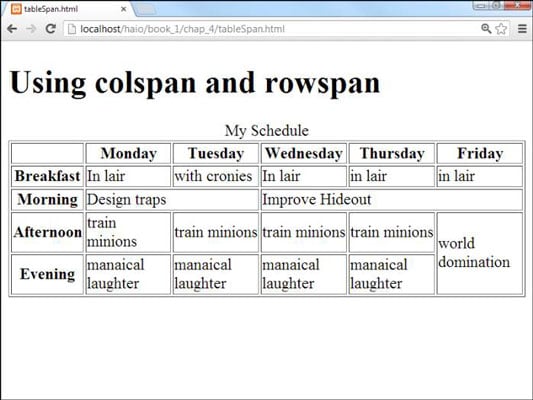
- Spanning row , for row

Chapter 3: “Functions, Methods, and Objects” (pp.106-144)
The way to create an “object type”, is to use an object constructor function.
CREATING OBJECTS USING CONSTRUCTOR SYNTAX
var hotel = new Object();
hotel.name= 'Park';
hotel.rooms = 120;
hotel .booked = 77;
hotel .checkAvailability = function()
return this . rooms - this.booked;
} ;
ADDING AND REMOVING PROPERTIES
do this using the dot notation.
hotel .gym = t rue;
hotel .pool = fal se;
delete hotel .booked;
RECAP: STORING DATA
In JavaScript, data is represented using name/value pairs. In arrays and objects the name is also known as a key.
- VARIABLES
A variable has just one key.
var hotel= 'Quay' ;
- ARRAYS
Arrays can store multiple pieces of information.
var hotel s = [
'Quay ' ,
' Park' ,
' Beach' ,
'Bloomsbury'
]